Evolution Doesn't Want You Happy (The Hedonic Treadmill)
Think about the last thing you really wanted. You got it — and for a while it was wonderful.
The Unintuitive Universe · July 13, 2026
And it’s been measured. Every claim traced to the published research. Method & sources ↗
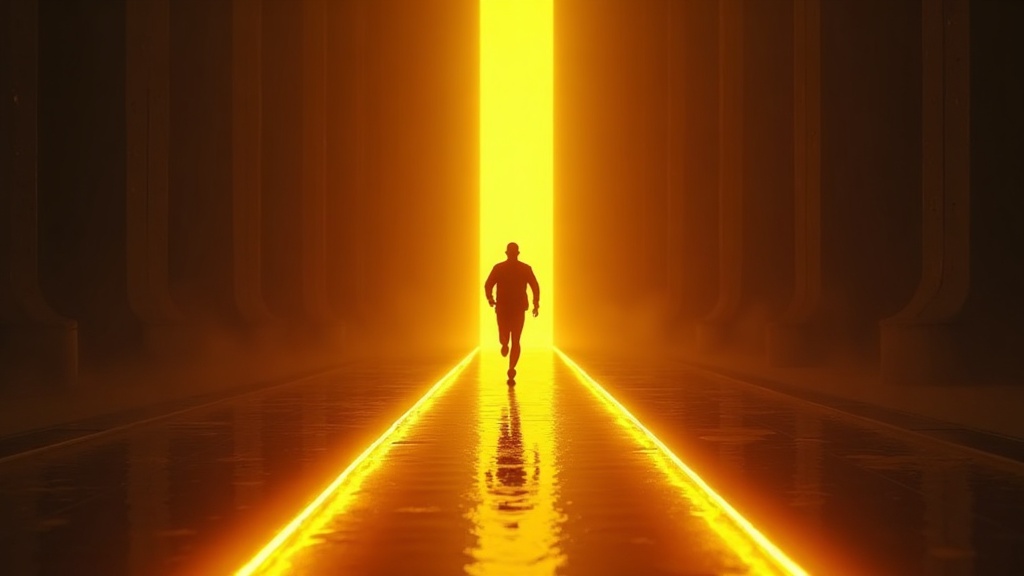
Think about the last thing you really wanted. The job, the person, the number in the bank, the thing you were sure would finally do it. Maybe you got it. And for a little while, it was wonderful. And then, quietly, the feeling drained away, and you found yourself reaching for the next thing.
That is not a personal failing. It is not weakness, or ingratitude, or a broken brain. It is exactly what you were built to do. Because the process that designed you was not trying to make you happy. It was trying to make you reproduce — and lasting happiness would have gotten in the way.
You were not built to be content. You were built to chase. Let me show you the machinery.
The Wrong Goal
Start with a hard fact about evolution. Natural selection does not care about your wellbeing. It cannot. It has no goals at all, really — it's just a filter. Whatever traits lead to more surviving offspring get passed on; whatever traits don't, vanish. That's the whole engine. The single currency is reproductive fitness. Not joy. Not peace. Not meaning. Just: did it make more copies.
So where does happiness even come in? Happiness is a tool. Evolution discovered that if it made certain fitness-boosting actions feel good — eating, winning status, sex, being loved by your group — animals would do more of them. Pleasure is the carrot on the stick. It was never the destination. It was only ever the thing that keeps you walking toward the destination the genes care about.
And a carrot only works if it stays just out of reach. Which is exactly how yours is built.
The Treadmill
Psychologists have a name for the thing you felt when your big win faded: hedonic adaptation. The hedonic treadmill.
Here's the pattern, and it's astonishingly consistent. Something great happens — a promotion, a new home, a windfall. Your happiness spikes. And then, over weeks or months, it slides back down to roughly where it started. Your baseline. The new car becomes just the car. The raise becomes the normal salary you now worry about losing. Even people who experience serious misfortune tend, over time, to drift back toward their baseline from the other direction.
You are on a treadmill. You run, you reach the thing, and the ground moves under you, and you're right back where you began, already eyeing the next thing. And the cruelest part is that it feels, every single time, like this next thing will be different. It won't. The treadmill is not a bug in your pursuit of happiness. The treadmill is the design.
Why It Fades On Purpose
Now, why would evolution build satisfaction to evaporate? Because permanent satisfaction is a fitness catastrophe.
Imagine an early human who achieved something — caught the food, won the mate, secured the status — and then felt perfectly, permanently content. Blissful. Done. That person stops striving. They don't hunt the next meal with the same urgency, don't compete for the next opportunity, don't worry about the winter coming. And right next to them is another human who got the same reward, felt good briefly, and then felt the itch return — the restlessness, the wanting more. Who out-reproduces whom?
The restless one. Every time. The one who could never quite be satisfied kept accumulating, kept competing, kept preparing — and left more descendants. So the genes for lasting contentment got out-bred, generation after generation, by the genes for divine dissatisfaction. You are descended from the ones who were never satisfied. That hollow feeling after you get what you wanted? It's not failure. It's your inheritance working exactly as designed.
The Useful Misery
It gets a little darker before it gets better. It's not just that the good feelings fade — it's that the bad ones were selected for too.
Anxiety, dread, envy, that gnawing sense that something is wrong. They're miserable to feel, and evolution kept them anyway, because they worked. Anxiety made your ancestors check for the predator. Envy made them compete for resources and mates. Dissatisfaction made them improve their situation. An evolutionary psychiatrist named Randolph Nesse describes it with the smoke-detector principle: a smoke alarm that occasionally shrieks at burnt toast is annoying, but far safer than one that stays quiet during a real fire. So evolution set your alarm to be trigger-happy. It is cheaper, in fitness terms, to feel a hundred needless worries than to miss the one that kills you. You are running anxiety software that is deliberately tuned to over-fire.
The Modern Mismatch
And now take that ancient machinery — built for a world of scarcity, small tribes, and real scarcity of food and status — and drop it into the modern world.
Your reward system, designed to chase calories that were once rare, meets an endless supply of engineered junk food. Your status-anxiety, designed to track your standing among a few dozen people you knew, now compares you to millions of curated strangers on a screen. Your novelty-seeking, meant to make you explore for resources, gets captured by feeds engineered to never end. The dissatisfaction that once pushed your ancestors to useful action now just spins, hijacked by things built specifically to exploit it. The treadmill didn't just stay on. Someone figured out how to sell tickets to it.
The Escape Hatch
So here's the reframe, and it's the reason this isn't a bleak story.
You were not built to be happy — but that means your unhappiness is not a verdict on your life. It's a mechanism. The restlessness you feel after every achievement is not the truth about how good your life is; it's a signal that evolved to keep you moving, firing whether or not it's telling you anything real. And the moment you can see it as a mechanism — this is the treadmill, this is the smoke detector, this is the ancient itch, not a message about my actual worth — it loses a lot of its grip.
That's the one crack in the design. Evolution built the wanting, but it also, by accident, built a creature that can notice the wanting and question it. You can savor the good thing on purpose, before it fades. You can stop believing the next thing will finally fix you. You can choose meaning and connection over the endless chase, because those, it turns out, resist the treadmill better than trophies do.
You will never win the game evolution set up, because it was rigged from the start to keep you playing. But you're the first animal that can look up from the board and see the rules. And seeing them is the closest thing to freedom the design ever left lying around.
That's the fine print on your own happiness. It's not a pursuit you're failing. It's a machine you can finally understand — which is exactly what this channel is for.
Sources
- Hedonic treadmill / adaptation: https://en.wikipedia.org/wiki/Hedonic_treadmill
- Randolph Nesse, evolutionary psychiatry & the smoke-detector principle (natural selection maximizes fitness, not happiness)