The Same Gene Builds Your Eye and a Fly's (Pax6)
Your eye is a camera — one lens, one chamber. A fly's eye is a mosaic of thousands of tiny tubes.
The Unintuitive Universe · July 14, 2026
And it’s been measured. Every claim traced to the published research. Method & sources ↗
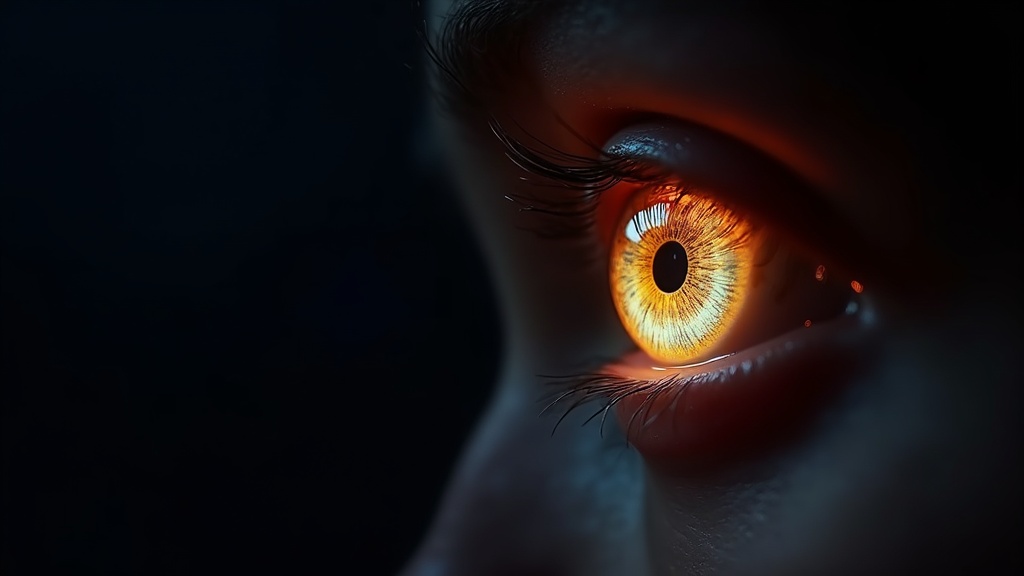
Look at your eye, and then look at the eye of a fly. They could not be more different. Yours is a camera: a single lens, focusing light onto a sheet of living film at the back of one round chamber. The fly's is a mosaic: thousands of tiny separate tubes, each catching one pixel of the world, packed together into a bulging dome.
Two completely different machines, built on completely different plans. If you had to guess, you'd say evolution invented eyes twice — once for us, once for the insects, with no connection between them.
You'd be wrong. Underneath those two designs sits the same gene, giving the same command. And we know it's the same, because scientists took that gene out of a mouse, put it into a fly, and the fly grew eyes. Let me show you a switch that has been building eyes for half a billion years.
The Master Switch
The gene is called Pax6, and it isn't a blueprint for an eye. It's a switch — a control gene that sits at the very top of the process, and when it flips on, it commands a cascade of some two thousand other genes to get to work building an eye underneath it.
You can tell how central it is by what happens when it breaks. In a fruit fly, damage this gene and the fly develops with no eyes at all — the mutant is literally named "eyeless." Break the same gene in a mouse, and you get a mouse with shrunken or missing eyes. Break it in a human, and the iris fails to form properly, a condition called aniridia. Flies, mice, people — the same single gene, and without it, in every case, the eyes don't get built.
That alone is a clue that something strange is going on. A fly and a human last shared an ancestor deep in the ancient oceans, more than half a billion years ago. Why would they be running the same master gene for such wildly different eyes?
The Experiment That Shouldn't Work
In the 1990s, Walter Gehring's lab in Switzerland decided to test just how powerful this switch really was. They took the Pax6 gene and forced a fly to switch it on in the wrong places — in the tissue destined to become a leg, a wing, an antenna.
The result was something out of a nightmare, and one of the most important images in modern biology. The fly grew extra eyes — real, structured, light-sensitive eyes — on its legs. On its wings. On its antennae. Wherever they turned the switch on, an eye tried to grow. A single gene, flipped on in the wrong spot, was enough to summon an entire eye into being where no eye belonged.
But that isn't even the punchline. Here's the punchline. When they ran the experiment again, they didn't use the fly's own version of the gene. They used the version from a mouse. A mammal's gene, dropped into an insect — two lineages separated by five hundred million years of evolution — and the mouse gene worked. It reached into the fly and ordered it to build eyes, and the fly obeyed.
But It Builds a Fly Eye
Now sit with the strangest part of all.
When the mouse gene told the fly to build an eye, the fly did not build a mouse eye. It built a fly eye — a little compound eye, thousands of tubes, exactly to the insect design.
And that reveals what this gene actually is. Pax6 does not carry the instructions for any specific eye. It carries one instruction: build an eye — here. It is a command, not a design. When the mouse's version shouts that command inside a fly, the fly hears "build an eye," and then answers in its own language, using its own downstream genes, and out comes the only kind of eye a fly knows how to make.
The switch is universal. The eye that follows is local. The mouse gene and the fly gene are saying the same word — and each body simply builds whatever that word means to it.
A Toolkit Older Than Eyes
Step back and think about what this means.
Roughly half a billion years ago, before there were flies or mice or people, before there were camera eyes or compound eyes, there lived some small, soft, probably wormlike creature in the sea — the last common ancestor we share with insects. And that creature already carried this gene, this switch, wired to a scrap of light-sensing tissue.
Every eye that has evolved since then inherited it. The eagle's eye and the octopus's eye, the fly's mosaic and the scallop's rows of mirror-eyes and the two you're using right now — all of them were built by descendants of that same ancient switch. Evolution did not invent the eye from scratch over and over. It invented a command for making eyes, once, unimaginably long ago, and then every branch of animal life reached for that same tool and built its own version.
Biologists call this deep homology: structures that look utterly unrelated on the surface, sharing a hidden genetic machinery far older than any of them. The designs diverged. The word underneath stayed the same.
The Same Ancient Word
So the fly on your windowsill is not the alien it appears to be. Its eyes and your eyes look like separate inventions, and as machines, they are. But they were switched on by the same gene, spoken in the same molecular word, handed down unbroken from a creature that swam in an ocean half a billion years before anything had a face.
You and that fly are running the same ancient subroutine. Life, it turns out, almost never invents from nothing. It finds a tool that works, and it reuses it — for eons, across every branch of the family, quietly, under designs that look nothing alike.
That's the fine print hidden inside your own eyes — and reading it is exactly what this channel is for.
Sources
- Halder, Callaerts & Gehring, "Induction of ectopic eyes by targeted expression of the eyeless gene in Drosophila," Science 267, 1788 (1995)
- Gehring, "The genetic control of eye development and its implications for the evolution of the various eye-types," Int. J. Dev. Biol. (2002)
- Quiring et al., "Homology of the eyeless gene of Drosophila to the Small eye gene in mice and Aniridia in humans," Science 265, 785 (1994)