The Truth About Hot Water Freezing First
Everyone's heard that hot water can freeze faster than cold — the Mpemba effect. Here's the honest version: in ordinary water it's genuinely disputed, a tangle of evaporation and convection that careful experiments often can't reproduce.
The Unintuitive Universe · July 26, 2026
And it’s been measured. Every claim traced to the published research. Method & sources ↗
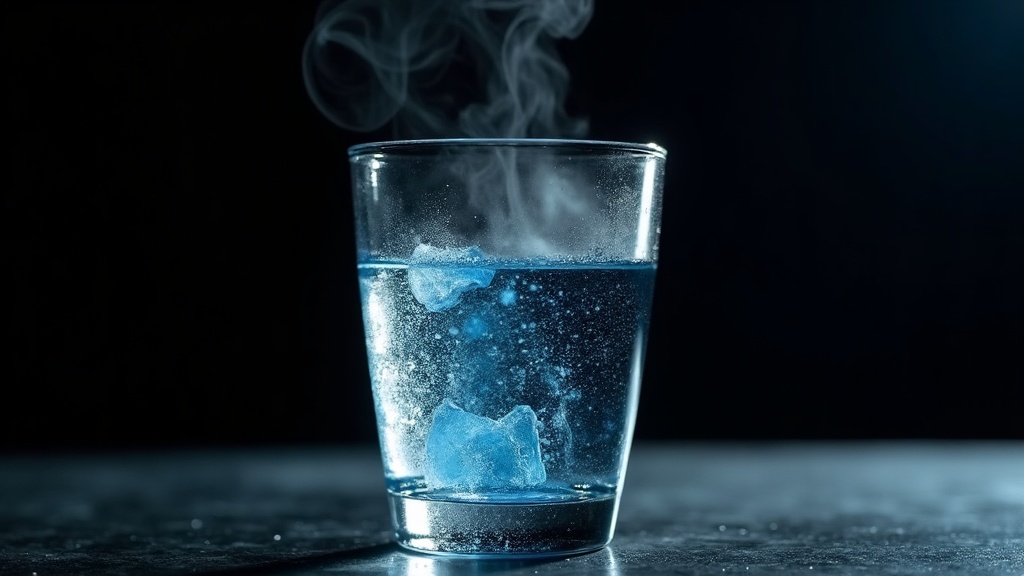
Fill two cups of water — one hot, one cold — and put both in the freezer. Which freezes first? The obvious answer is the cold one. It has a head start. It is already closer to ice. And yet, for two thousand years, people have reported the opposite: sometimes the hot water wins. Aristotle noticed it. A Tanzanian schoolboy named Erasto Mpemba got it named after him in 1969, after his hot ice-cream mix set before his classmates' cold one.
Here is the honest catch, and it matters. In ordinary water, the effect is a mess. Some careful experiments see it; others, controlling every variable, cannot reproduce it at all. In plain water it may not be a clean law so much as a tangle of evaporation, convection, and dissolved gas. If that were the whole story, it would just be a footnote.
But hiding inside the folklore is a real, and much stranger, idea. Forget water. Ask the general question: when something relaxes toward its resting state — cooling, settling, calming down — does starting farther away always mean taking longer? Intuitively, yes. Farther is slower. And intuitively, that is wrong.
Because relaxation is not a single slide down a hill. A system settles by shedding many patterns at once, each one fading at its own rate — and the last stretch is always ruled by the slowest-fading pattern of all. Here is the trick. A state that starts more extreme can happen to carry less of that slowest pattern. It is farther from home, but it left behind the very thing that makes the final approach drag. So it arrives first. In 2017, physicists put this on rigorous footing: the path back to equilibrium depends not on how far you start, but on which fading patterns you carry.
That turned a soggy kitchen curiosity into something you could test cleanly. And in 2024, physicists did — in a place with no evaporation and no convection at all: a chain of individual ions, held by lasers, standing in for a quantum system. They prepared it in states of broken symmetry — some barely lopsided, some wildly so — and watched each one heal back to balance. The result was the paradox in its purest form. The more lopsided the start, the faster it healed. The system that began the most broken finished first.
They call it the quantum Mpemba effect, and it is cleaner than anything water ever offered, because here the cause is exact. A more asymmetric state can overlap less with the slowest-relaxing mode — so the stubborn, last-to-fade piece that holds an ordinary system back is simply weaker from the start. Farther out, but lighter where it counts.
And this is not a quirk of ice or ions. It is a statement about how things return to rest, and it keeps turning up — in cooling, in magnets, in how fast a quantum computer can be reset to a clean state before its next calculation. Wherever something relaxes, the shortest way back may not begin at the nearest point.
So the next time someone tells you the cold cup obviously wins because it started closer, you will know the quiet truth underneath. Arriving first was never only about how far you had to travel. It was about what you carried — and how fast you could let it go.
Sources
- Mpemba & Osborne, "Cool?", Physics Education 4, 172 (1969)
- Burridge & Linden, "Questioning the Mpemba effect: hot water does not cool more quickly than cold," Scientific Reports 6, 37665 (2016)
- Lu & Raz, "Nonequilibrium thermodynamics of the Markovian Mpemba effect and its inverse," PNAS 114, 5083 (2017)
- Joshi et al., "Observing the Quantum Mpemba Effect in Quantum Simulations," Physical Review Letters 133, 010402 (2024)