The Sun Shouldn't Shine (Quantum Tunneling Explained)
Right now, 93 million miles away, the Sun is doing something the laws of classical physics say it cannot do. Its core is far too cold to fuse hydrogen — the protons simply don't have the energy to overcome their own electric repulsion.
The Unintuitive Universe · July 13, 2026
And it’s been measured. Every claim traced to the published research. Method & sources ↗
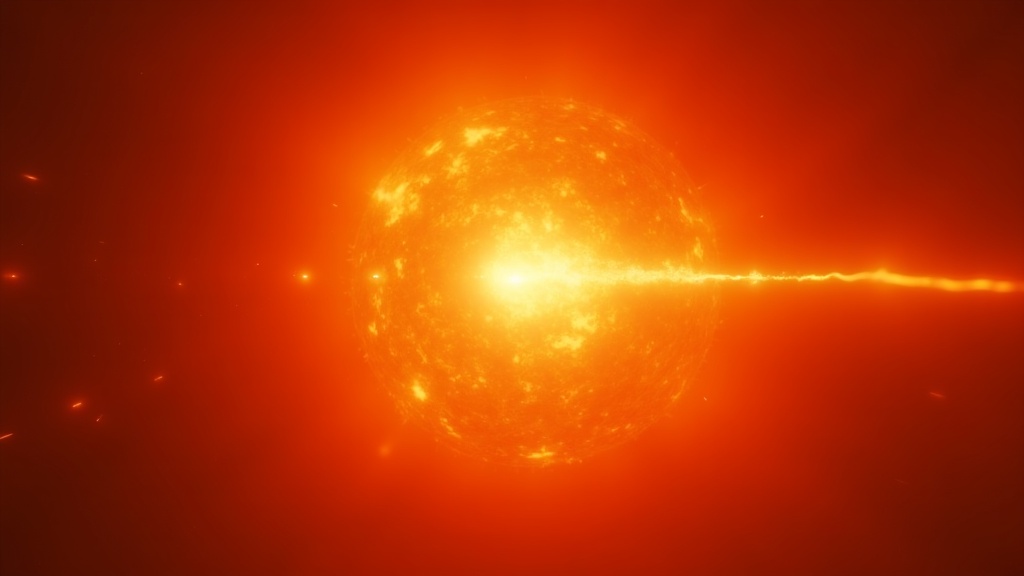
Right now, ninety-three million miles away, the Sun is doing something the laws of physics say it cannot do. By the strict, classical rules — the physics of Newton, the physics of everyday cause and effect — the core of the Sun is far too cold to burn. The fire that lights our sky, grows our food, and made every living thing possible should not exist.
It burns anyway. And the only reason it does is that particles, down at the smallest scale, are able to walk through walls they have no right to cross. Sunlight is the proof. Let me show you why the Sun should be dark.
The Wall in the Core
The Sun runs on nuclear fusion: it slams hydrogen nuclei — protons — together hard enough to fuse them into helium, releasing energy. Simple enough. Except protons carry positive electric charge, and like charges repel. The closer two protons get, the harder they shove each other apart.
To fuse, they have to get ridiculously close — within about a femtometer, a millionth of a billionth of a meter — close enough for the strong nuclear force to grab them. But to get that close against their own furious repulsion, they need to overcome an enormous energy barrier. Physicists call it the Coulomb barrier. Picture it as a steep hill each proton has to climb before it can fall into the other's arms.
So how much energy do the protons in the Sun's core actually have? The core sits at about fifteen million degrees. That sounds like plenty. It isn't. At that temperature, a typical proton carries roughly a thousand times too little energy to climb the Coulomb barrier. Not a little short. Off by a factor of a thousand.
The Number That Should End the Story
Let me make the failure precise, because the number is genuinely staggering.
If you assume classical physics — protons as tiny balls that must climb over the barrier — and you calculate the odds that two protons in the Sun's core ever get close enough to fuse, you get a probability of about one in ten to the two-hundred-ninetieth power.
Take a breath at that number. Ten to the two-hundred-ninetieth. There are only about ten to the eightieth atoms in the entire observable universe. The odds against solar fusion, classically, are more lopsided than picking one specific atom out of a universe of universes. It is not "unlikely." It is zero, in every practical sense.
By classical physics, the Sun has no business fusing a single pair of protons. It should be a cold, dark ball of gas. And yet you can walk outside and feel it on your skin. So the classical story is simply, provably wrong. Something else is happening.
Walking Through the Wall
In 1928, a physicist named George Gamow found the missing piece, and it's one of the strangest facts in all of science: quantum tunneling.
In quantum mechanics, a particle isn't a hard little ball sitting at one spot. It's a smeared-out wave of probability. And that wave doesn't stop dead at a barrier — it leaks into it, and a faint tail of it seeps out the other side. Which means there is always a small, real chance of finding the particle on the far side of a wall it never had the energy to climb over.
It didn't go over the barrier. It didn't smash through it. It simply... appeared on the other side. As if the wall were, for that one particle, briefly optional. That's tunneling.
In the Sun's core, protons that could never climb the Coulomb barrier tunnel straight through it. The probability for any single pair is still tiny — but the Sun's core has an almost unimaginable number of protons, colliding constantly, for billions of years. And a tiny chance, multiplied by a staggering number of tries, becomes a steady, roaring fire.
The Slow Fire That Saved Us
Here's the beautiful part. Tunneling doesn't make fusion easy — it makes it just barely possible. And "just barely" turns out to be exactly what we needed.
Because fusion in the Sun is so rare, so reluctant, so dependent on an improbable quantum leak, the Sun burns slowly. Agonizingly slowly. It sips its hydrogen over ten billion years instead of detonating all at once. If tunneling made fusion easy, the Sun would have flared and died long before Earth cooled, long before life had a chance. The very improbability that should have kept the Sun dark is what lets it burn gently enough, and long enough, for us to exist under it.
Every photon of sunlight began as two protons that, by the rules you were taught, never should have met — meeting anyway, by passing through a wall.
The Impossible, Constantly
So the next time you step into the sun and feel that warmth land on your face, hold this in your mind: what you are feeling is the heat of the impossible.
By the physics of the ordinary world, the Sun cannot shine. The protons in its heart do not have the energy to overcome their own repulsion — the odds against it are one in ten to the two-hundred-ninetieth. The Sun shines only because, at the quantum scale, particles routinely do the forbidden thing and slip through barriers they cannot cross. Sunlight is not just light. It is direct, daily, planet-warming evidence that the impossible happens — trillions upon trillions of times a second, in a furnace ninety-three million miles away.
The universe runs on a rule your intuition would never allow. And it has been keeping you alive your entire life.
That's the kind of thing hiding behind the most ordinary sight there is — a sunny day. Which is exactly why it's worth looking at the fine print.
Sources
- Gamow factor & tunneling in stellar fusion: https://en.wikipedia.org/wiki/Gamow_factor
- Quantum tunneling in the Sun: https://evincism.com/quantum-tunneling-in-the-sun/