Scientists Built a Mirror for Time
For all of history, a mirror could only reflect you in space — left becomes right, but the moment stays the same. In 2023, physicists built the other kind: a mirror in time.
The Unintuitive Universe · July 26, 2026
And it’s been measured. Every claim traced to the published research. Method & sources ↗
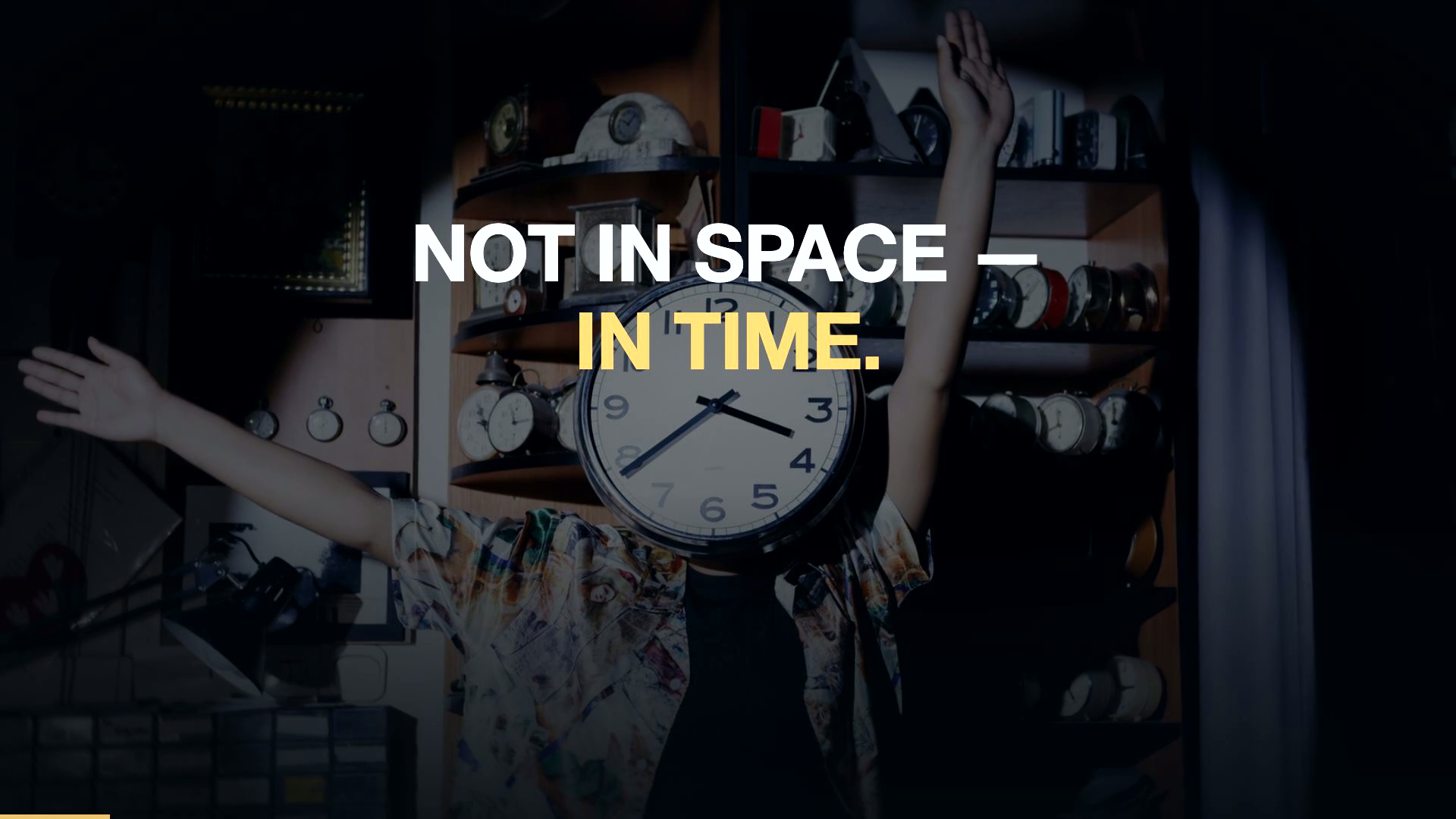
Look in a mirror. What comes back is a reflection in space — left becomes right, but the moment stays the same. For all of history, that was the only kind of reflection we knew how to make. In 2023, physicists made the other kind: a mirror that reflects you not in space, but in time. And what it sends back is you, played backward.
To see how, start with any wave — light, sound, a ripple running down a rope. A wave travels until it meets a boundary in space: the surface of a mirror, the end of the rope, a wall. At that edge, the world it is moving through suddenly changes, and part of the wave turns around. It reverses direction, but it keeps its frequency — its color, its pitch. That is an ordinary reflection. A change in space.
Now do something that sounds impossible. Instead of changing the world at one place, change it everywhere — the entire medium the wave is travelling through, its whole universe, flipped in a single instant. The boundary is no longer a line in space. It is a moment in time.
The wave reflects off that moment. And a reflection in time is nothing like a reflection in space. It comes back reversed in time — the part that arrived last leaves first, the whole signal running in reverse, like a recording played backward. And it comes back a different color, its frequency shifted, because a boundary in time changes a wave in exactly the way a boundary in space cannot.
That mirror-image behavior is the heart of it. Physicists call it space-time duality. A boundary in space keeps a wave's frequency but can change its momentum — that is why a mirror turns light around. A boundary in time does the opposite. It keeps the momentum, the spatial pattern, and changes the frequency instead. Every rule you know about mirrors and lenses has a hidden twin, written in time — and almost no one has ever seen the other half of the book.
Here is why. The idea is old; it was predicted back in 1958. But to actually reflect a wave in time, you have to switch the entire medium's properties faster than the wave can finish a single oscillation, everywhere, all at once. For visible light, which oscillates hundreds of trillions of times a second, that is hopeless. So the prediction sat, untouched, for sixty-five years.
Then a team led by Andrea Alù found a way around it. Instead of light, they used radio waves — which oscillate far more slowly — running down a specially built metamaterial, a strip packed with switches. And in a fraction of a billionth of a second, they flipped the entire strip's electrical properties, all of it, at once. The wave inside reflected off that instant. It came back time-reversed and frequency-shifted, exactly as the sixty-five-year-old math said it must. The first time reflection of an electromagnetic wave ever seen.
Two honest notes, because the real story is stranger than the hype. This was done with radio-frequency signals in an engineered material — not a beam of visible light, whatever a headline might tell you. And nothing here travels backward through time. It is the wave's shape that is reversed, not the clock. What bends is not time itself, but the behavior of a wave meeting a wall made of time.
And it cracks open a door. Make not one boundary in time but a rhythm of them — flip the medium over and over — and you build what is called a photonic time crystal, where each flip can pour energy into the wave, and a faint signal can grow brighter on its own. A mirror in space sends a wave back. A rhythm of mirrors in time can send it back stronger.
We have had the mirror that reverses space for centuries. The one that reverses time is barely three years old. And it is telling us something the equations always whispered but we could never test — that the universe holds space and time as reflections of each other. We just finally learned how to stand in front of the second mirror.
Sources
- Moussa, Xu, Galiffi, Yin, Ramaccia, Alù, "Observation of temporal reflection and broadband frequency translation at photonic time interfaces," Nature Physics 19, 863 (2023)