You Are Two Creatures (The Bacteria That Became You)
You think of yourself as one organism, built from one genome. But inside nearly every one of your cells is a second, separate loop of DNA — kept apart from your own, and written in the format of a bacterium.
The Unintuitive Universe · July 14, 2026
And it’s been measured. Every claim traced to the published research. Method & sources ↗
You think of yourself as one organism. One body, one life, built from one set of instructions — the genome you inherited, copied into every cell. A single, unified you.
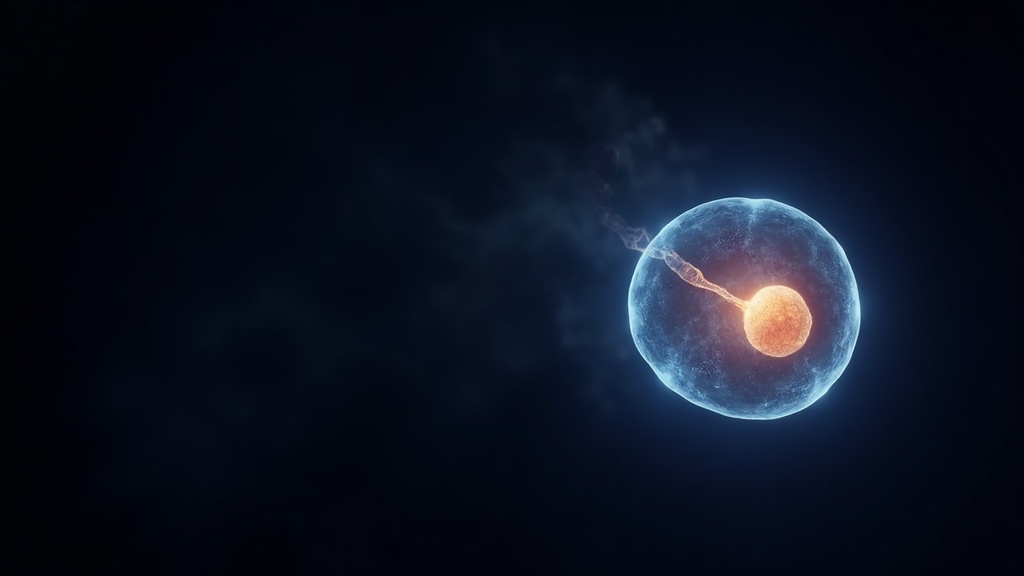
But that's not quite true. Because inside nearly every one of your cells, there is a second set of instructions. A separate loop of DNA, kept in its own compartment, apart from the rest of your genes. It doesn't match the filing system of the rest of you. It's written more like the DNA of a bacterium — because that is exactly what it once was.
Tucked inside your cells are the descendants of a creature that was never you. Around two billion years ago, it was swallowed, and never digested. It stayed. And it has been living inside your ancestors, and now inside you, ever since. You are not one creature. You are two, fused so long ago you forgot there was ever a seam.
The Cell Within the Cell
The strangers are your mitochondria. You've probably heard them called the powerhouse of the cell — the little structures that turn your food and the oxygen you breathe into usable energy. Every beat of your heart, every thought, every movement is paid for in energy they produce. Without them, complex life simply switches off.
But look closely at how a mitochondrion behaves, and it starts to seem less like a part of you and more like a lodger. It carries its own DNA — a small, circular loop, completely separate from the vast library of instructions locked in your cell's nucleus. It builds some of its own machinery from that private blueprint. And it multiplies on its own schedule, splitting in two the way bacteria do, independent of the cell it lives in.
An organ of your body that has its own genome and its own private life? That is a very strange thing to find inside yourself — unless it was never fully yours to begin with.
The Swallowing
Here is what the evidence says happened, in the deep past, before there were animals or plants or anything you would recognize as alive.
The world was full of single cells. Some of them had learned a powerful trick: using oxygen to extract energy from food with tremendous efficiency. And one day, one larger cell engulfed one of these little energy-makers — the way it would swallow any meal.
But this time, it didn't digest it. For reasons we can only reconstruct, the swallowed bacterium survived inside its captor. And it turned out to be worth keeping. The little cell kept making energy — now for its host. The host offered shelter and a steady supply of raw materials. What began as predator and prey settled into a truce, and the truce, over countless generations, hardened into something permanent. Two organisms became one. Neither could go back.
This idea — that a major part of your cells was once a free-living bacterium — sounds absurd the first time you hear it. When the biologist Lynn Margulis proposed it in the 1960s, it was ridiculed and rejected by journal after journal. Today it is in every biology textbook on Earth. Because the proof turned out to be hiding in your own cells the whole time.
The Proof in Your Cells
Start with that separate DNA. Your own chromosomes are long and linear, like sentences with a beginning and an end. Your mitochondria's DNA is a closed circle — which is exactly the shape bacteria keep their genomes in. It's the wrong format to be one of yours. It's a bacterial format.
Then there's the double wall. A mitochondrion is wrapped in not one membrane but two, nested one inside the other — precisely what you'd expect if an outer bag, the moment of being swallowed, had closed around a smaller cell that already had a skin of its own. It's a frozen snapshot of the swallowing, still there in every cell.
And then there's the strangest inheritance of all. The mitochondria in your body did not come from both your parents. They came, almost entirely, from your mother — passed down in the egg, an unbroken chain from mother to child stretching back and back through time. Follow that maternal line far enough and it converges on a single woman who lived in Africa, whom scientists nickname Mitochondrial Eve — not the only woman alive then, but the one from whom every human being's mitochondria descend. Your power plants have their own family tree, and it is not quite the same as yours.
The Bargain That Built You
Now step back and see what that ancient swallowing bought.
A single cell on its own can only generate so much energy across its surface. But a cell packed with hundreds or thousands of these internal power plants has a vast energy budget to spend — enough to run a big, complicated genome, to build intricate machinery, to become large and complex. Many biologists think this merger was the event that made complex life possible at all. That without it, life on Earth might have stalled forever as a film of simple cells, and never become anything that could swim, or grow a hand, or wonder about itself.
Which means that every breath you take is, in a real sense, for them. You pull in oxygen and hand it down to these captive descendants of a swallowed microbe, so they can keep burning your food and keep you running. You are the shelter. They are the engine. And the deal has held for two billion years.
The Seam You Can't See
So you are not one thing. You are a collaboration — a merger so old and so complete that the two partners have all but disappeared into each other. A host cell and a domesticated bacterium, bound together since a time before eyes, before bones, before thought, still keeping their separate genomes side by side inside you right now.
They are no longer free; they can't survive on their own anymore, and neither can you without them. Two lineages that met once, in the body of a single cell, and simply never parted. Every heartbeat is powered by a guest that came in two billion years ago and stayed for good.
That's the fine print written into your own cells — and reading it is exactly what this channel is for.
Sources
- Lynn Sagan (Margulis), "On the origin of mitosing cells," J. Theoretical Biology 14, 255 (1967)
- Margulis, "Origin of Eukaryotic Cells" (1970)
- Nick Lane, "The Vital Question: Energy, Evolution, and the Origins of Complex Life" (2015)